
The Hidden Cost of Fragmented Reminders (and Fixes)
Fragmented reminders raise cognitive load and increase missed follow-ups. Learn common patterns and a practical, offline-friendly consolidation approach.
Fragmentation: the productivity tax you don’t see

When your reminders live everywhere—calendar events, chat pings, sticky notes, email flags, and half-used apps—you pay a quiet productivity tax. Each tool has its own rules (where it stores items, how it notifies you, what “done” means). Your brain becomes the integration layer, constantly translating and checking. That invisible switching cost adds up as cognitive-load: you’re not just remembering the task, you’re remembering where you put the task.
Fragmented task-management also creates false confidence. A message to yourself in a group chat feels captured, but it’s buried by the next thread. A calendar entry is time-bound, but many tasks are flexible until they suddenly aren’t. Over time, this erodes trust in your system and weakens your habits—you stop reviewing because review doesn’t reliably surface what matters.
Digital-minimalism isn’t about using fewer tools for the sake of it; it’s about reducing “reminder entropy.” A single, dependable capture point lowers friction, so follow-through becomes the default instead of an ongoing mental negotiation.
Common fragmentation patterns that increase failure rates
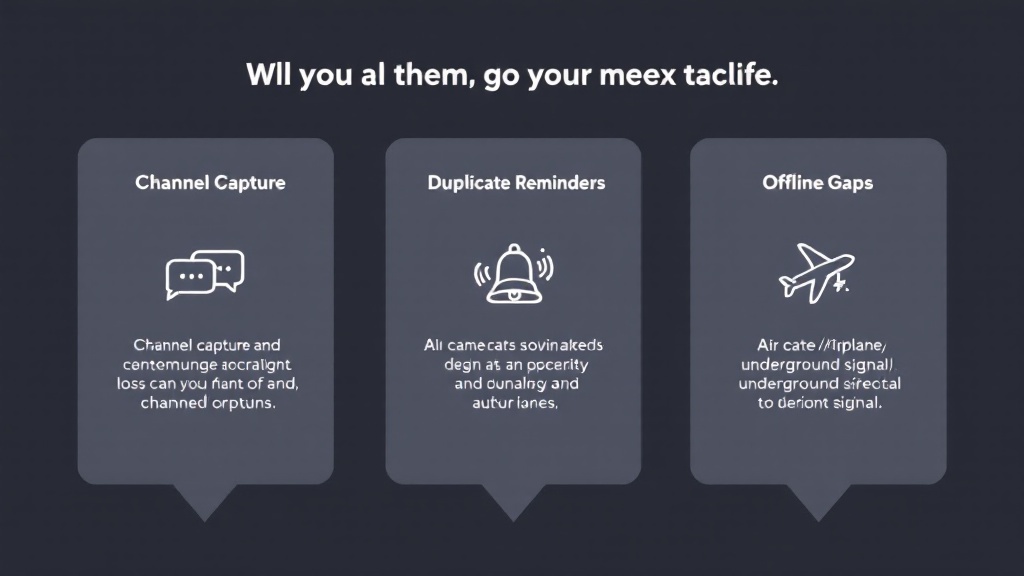
One common pattern is the “channel capture” trap: tasks get recorded in whatever tool you’re using at the moment—Slack/DMs, texts, email, notes, or a calendar—then never re-entered into a trusted list. Another is “duplicate reminders,” where you set multiple alerts across apps to compensate for distrust. Ironically, duplication increases noise, which makes it easier to swipe away the important ping with the trivial one.
A second pattern is mismatched context. Calendars are great for fixed appointments, but many tasks are better handled as flexible next actions with optional deadlines. When tasks are forced into calendar time blocks, they get rescheduled repeatedly, creating fatigue and avoidance. The third pattern is “offline gaps”: you remember something on a commute, in a basement classroom, or mid-flight, but your tool requires connectivity or too many steps. The moment passes, and the task evaporates.
These patterns are why digital-minimalism and better habits often start with a single, low-friction inbox—one place to capture instantly, then sort later when you can think clearly.
A practical consolidation approach (that still fits real life)

A consolidation plan doesn’t require abandoning your calendar or messages; it requires deciding which tool is the source of truth for actionable items. Start with one fast capture point: a one-tap inbox where every new task lands, regardless of origin. When a chat message implies work, capture the action in your inbox (not the conversation). When an email needs follow-up, capture the next step as a task. This reduces cognitive-load because you’re no longer tracking tasks by remembering their hiding places.
Next, add lightweight structure: a few lists (School, Work, Personal) and a weekly review ritual. Use reminders for truly time-sensitive items and recurring alerts for routines—this is where consistent task-management strengthens habits. Crucially, make sure the system works offline so capture and planning don’t depend on signal.
Local-first apps (for example, PocketPrompt Tasks) are designed for this reality: instant capture, reliable notifications, and optional sync across devices while staying usable offline. That combination supports productivity and digital-minimalism—fewer places to check, fewer missed deadlines, and more confidence that “captured” actually means handled.